Thesis Structure: The Complete Framework (With Free Outline Template)
You know your research. You know your findings. But staring at a blank document trying to figure out what goes where, which chapter comes first, and how to connect 80 pages of ideas into something your committee will approve is a different kind of hard. The number one reason graduate students stall on their thesis isn’t writer’s block on the content. It’s not knowing how to structure the whole thing.
This guide covers thesis structure from start to finish: the standard chapter framework most programs expect, what belongs in each section, how to organize your argument so it builds logically, and the differences between empirical, humanities, and manuscript-format theses. You’ll also get a free thesis outline template that walks you through planning every chapter before you write a word.
What Is Thesis Structure?#
Thesis structure is the organizational framework that determines how your research is divided into chapters, sections, and subsections, and in what order those pieces appear. It’s not the same as thesis formatting (which covers margins, fonts, and page numbers — see our thesis formatting guide for that). Structure is about the intellectual architecture: what goes where and why.
A clear thesis structure does three things. It gives readers a predictable path through complex research. It ensures your argument builds logically from context to evidence to interpretation. And it satisfies the expectations of your committee, who will be looking for specific elements in specific places.
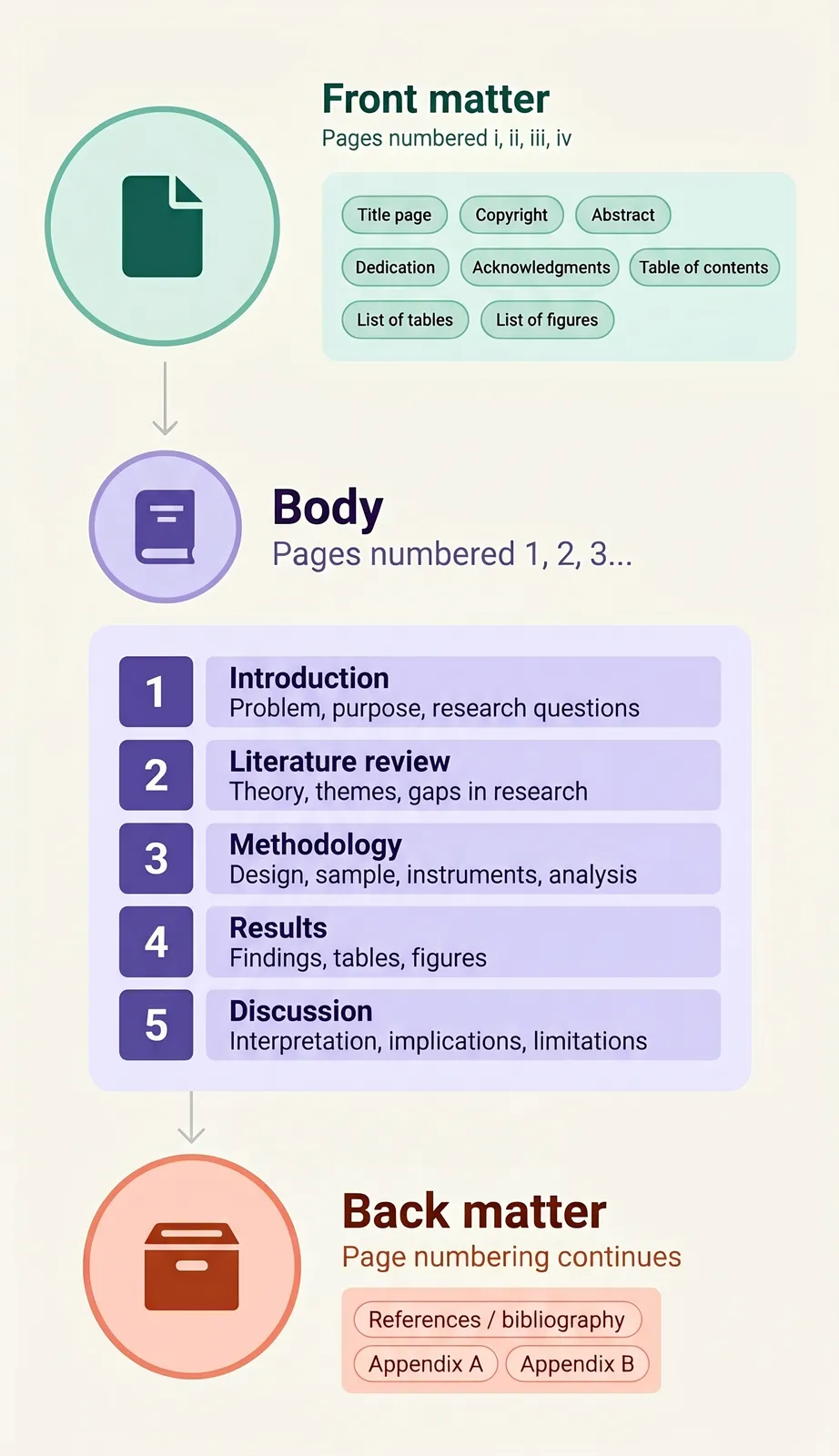
The structure of your thesis depends on your discipline, your research type, and your program’s requirements. But the frameworks are more standardized than most students realize. Nearly every thesis fits one of three models.
The Standard 5-Chapter Thesis Structure#
The five-chapter structure is the most common thesis structure across the sciences, social sciences, education, nursing, business, and many other fields. This is an example of thesis structure that most graduate programs expect for empirical research.
Chapter 1: Introduction#
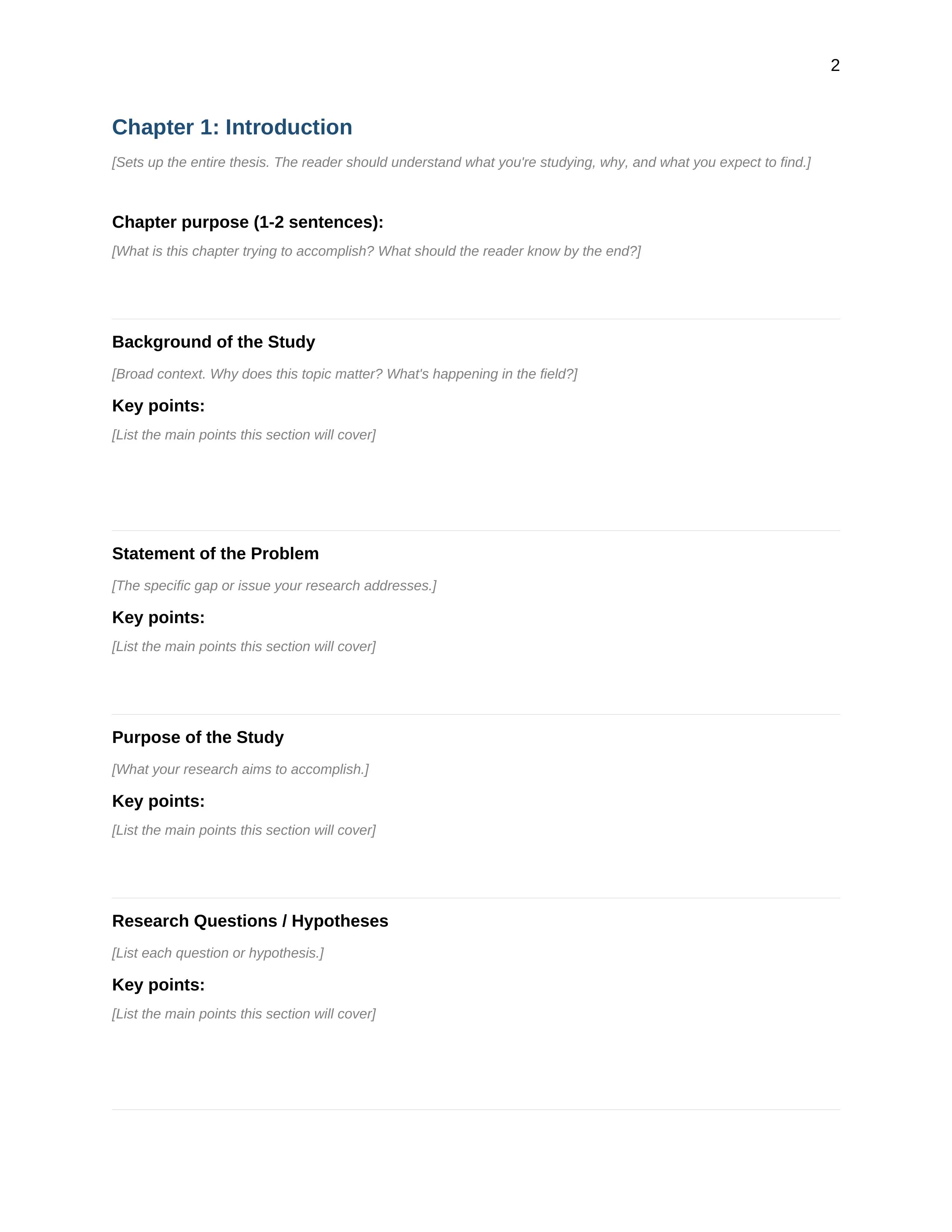
The introduction chapter sets up everything that follows. By the end of this chapter, your reader should understand what you studied, why it matters, and what you set out to discover.
Background of the study. Start broad. What’s happening in the field that makes your topic relevant? What trends, problems, or developments led you to this research? This is context, not a literature review. Keep it to two or three pages.
Statement of the problem. Narrow to the specific issue. What gap exists in current knowledge? What isn’t working? What hasn’t been studied? This is the single most important paragraph in your entire thesis, because every other section flows from it.
Purpose of the study. One to two sentences stating exactly what your research aims to accomplish. “The purpose of this study is to examine…” Keep it precise.
Research questions or hypotheses. List them. Number them if you have more than one. These are the questions your thesis answers. Every subsequent chapter should connect back to them.
Significance of the study. Who benefits from this research? Why should anyone outside your committee care? Connect your work to practice, policy, or the broader field.
Definition of key terms. Any term that has a specific or technical meaning in your study gets defined here. This prevents misinterpretation later.
Overview of the thesis. A brief roadmap: “Chapter 2 reviews the existing literature on… Chapter 3 describes the methodology…” One sentence per chapter.
Chapter 2: Literature Review#
The literature review demonstrates that you know the field. It’s not a list of summaries. It’s a synthesis of existing research organized by theme, showing where your study fits in the broader conversation.
Theoretical framework. The theory or model that frames your research. Explain what it is, why you chose it, and how it shapes your approach. This is the lens through which your data will be analyzed.
Thematic sections. Organize your review by theme, not by source. Group studies that address similar questions or use similar methods. For each theme, summarize what’s been found, where findings conflict, and what remains unclear.
Gaps in the literature. End the chapter by identifying what hasn’t been studied. This is the justification for your thesis. The gap you identify should map directly to your research questions from Chapter 1.
A common mistake: organizing the literature review source by source (“Smith (2020) found… Jones (2021) found… Lee (2022) found…”). This reads like an annotated bibliography, not a critical synthesis. Group by theme and weave sources together.
Chapter 3: Methodology#
The methodology chapter explains how you conducted your research. It should be detailed enough that another researcher could replicate your study.
Research design. Qualitative, quantitative, or mixed methods? Case study, experimental, survey, ethnographic? State the design and explain why it’s appropriate for your research questions.
Participants or sample. Who or what you studied. How many. How they were selected. Inclusion and exclusion criteria. For quantitative research, explain your sample size calculation.
Instruments or materials. What you used to collect data: surveys, interview protocols, observation rubrics, existing datasets. If you used a validated instrument, cite it. If you created your own, explain the development process.
Data collection procedures. Step by step, what you did. Timeline, sequence, settings. Enough detail that someone reading this could do the same thing.
Data analysis methods. How you analyzed the data. Statistical tests and software for quantitative research. Coding schemes and approaches (thematic analysis, grounded theory, etc.) for qualitative research.
Ethical considerations. IRB approval, informed consent, anonymity, data storage. This is required by every institution.
Chapter 4: Results#
The results chapter presents your findings without interpretation. What did you find? Save the “what does it mean” for Chapter 5.
Organization. Present results in the same order as your research questions. If you had three research questions, organize this chapter around those three questions.
Tables and figures. Use them. A well-designed table communicates data more effectively than paragraphs of numbers. Each table and figure needs a number, a title, and a note if needed. Refer to every table and figure in the text.
Statistical results. Report them using the conventions of your field. In APA style: t(24) = 2.50, p = .019, d = 0.72. Include effect sizes, not just significance values.
Qualitative findings. Organize by theme. Include representative quotes as evidence. A sample outline for qualitative results might use two to four major themes, each with two or three subthemes supported by participant quotes.
Chapter 5: Discussion#
The discussion chapter interprets your results and connects them back to the literature and your research questions.
Summary of findings. Brief recap. One paragraph restating your main results, connecting each to the research question it answers.
Interpretation. What do the results mean? How do they compare to what previous studies found? Where do your findings align with existing research, and where do they diverge? This is where you bring your literature review back into the conversation.
Implications. For practice (how should people do things differently?), for policy (what should change?), for theory (does this support, extend, or challenge the theoretical framework?).
Limitations. Every study has them. Be candid about sample size, measurement issues, generalizability, or methodological constraints. Acknowledging limitations shows maturity, not weakness.
Recommendations for future research. What should the next researcher study? What questions did your research raise?
Conclusion. End with a clear, confident statement about what your research contributes to the field. Not a summary of the thesis. A statement of significance.
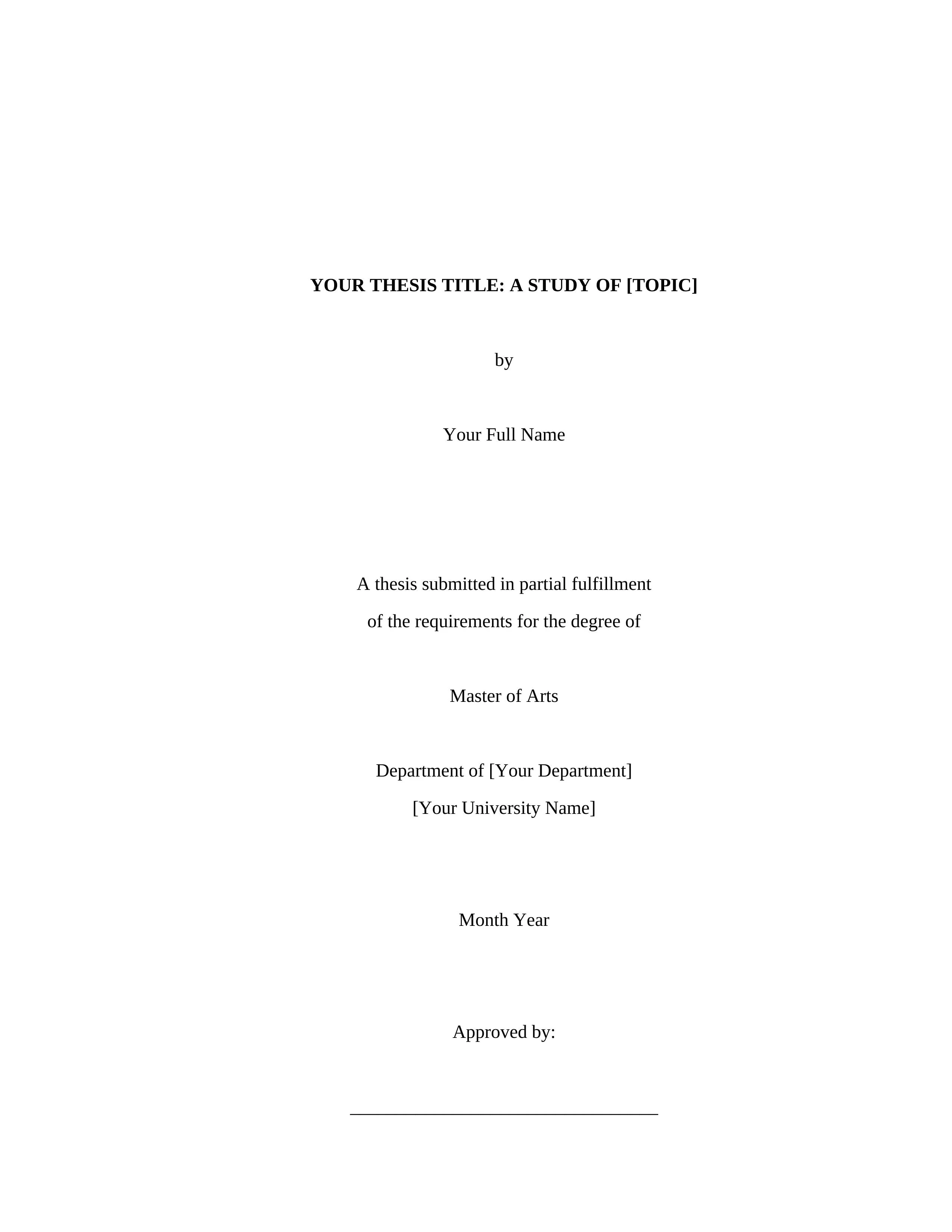
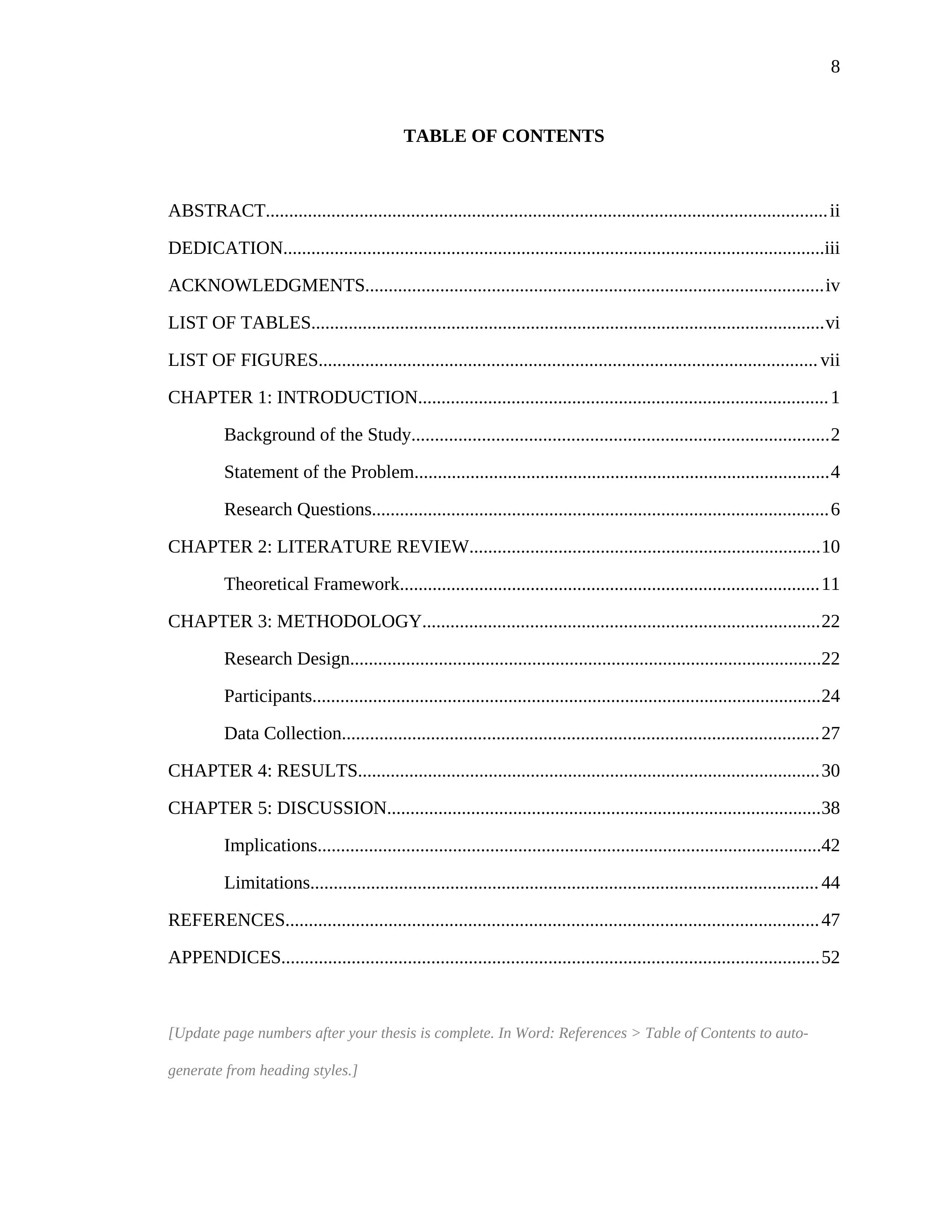
The 3-Chapter Humanities Thesis Structure#
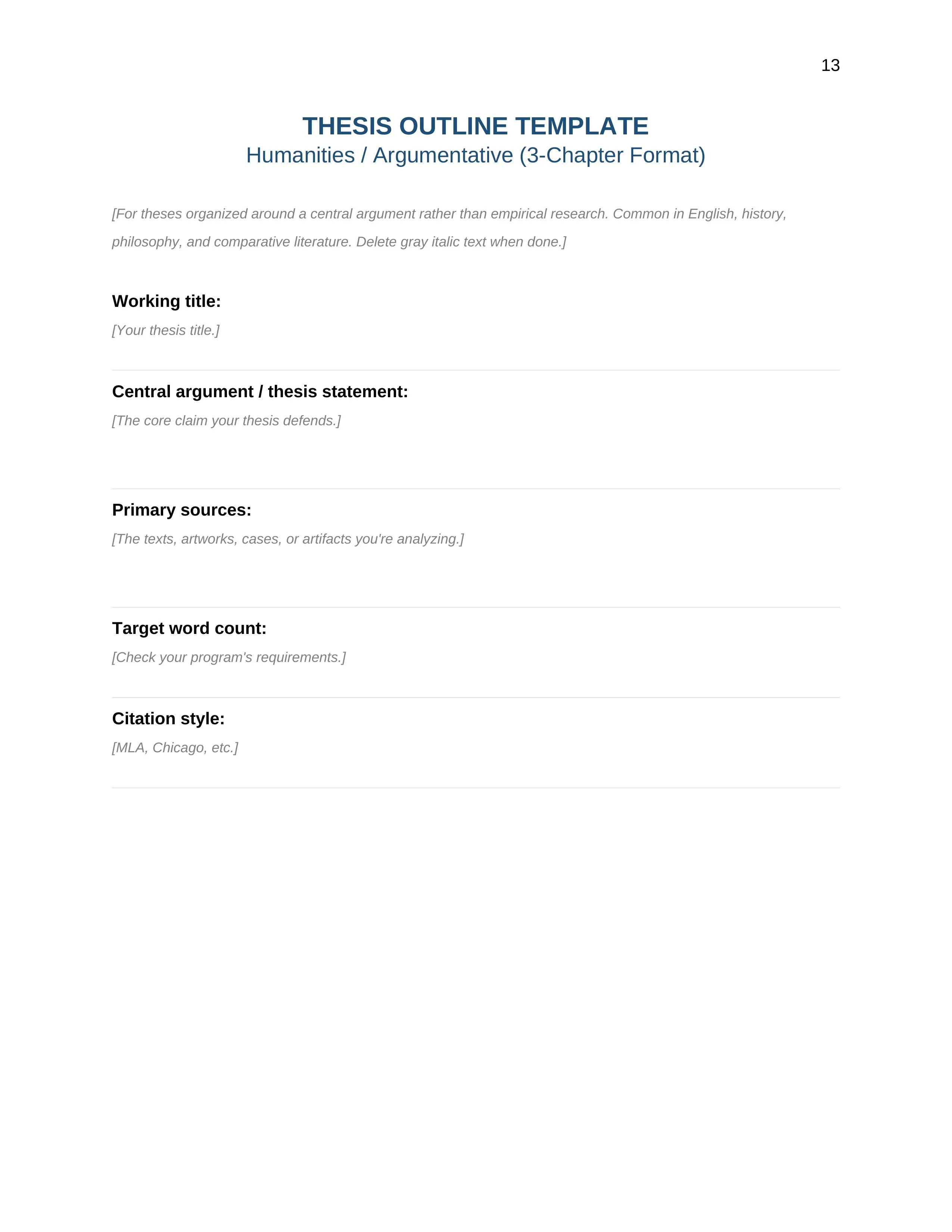
Humanities theses (English, history, philosophy, comparative literature, art history) often follow a different model. Instead of presenting empirical data, they build an argument through close analysis of primary sources.
Chapter 1: Introduction and Context. Establishes the critical or historical context, reviews relevant scholarship, states the thesis argument, and describes the methodology (close reading, archival research, comparative analysis). Ends with a chapter overview.
Chapter 2: Analysis. The core of the thesis. Divided into sections, each analyzing a different aspect of the primary sources or building a different component of the argument. This is where the original intellectual work happens.
Chapter 3: Conclusion. Summarizes the argument, discusses broader implications for the field, acknowledges limitations, and suggests directions for future scholarship.
Some humanities theses use four or five chapters, splitting the analysis into multiple focused chapters. The structure depends on the material and the argument. A thesis on three novels might give each novel its own chapter. A thesis on a historical period might organize chronologically. Your committee determines the structure that best serves your argument.
The Manuscript-Format Thesis#
Some programs, especially in STEM fields, allow a manuscript-format thesis. Instead of the traditional five chapters, you bundle two or three journal articles (published, submitted, or in preparation) with a general introduction and conclusion.
The structure typically looks like this: Chapter 1 (General Introduction), Chapter 2 (Paper 1), Chapter 3 (Paper 2), Chapter 4 (Paper 3), Chapter 5 (General Discussion). Each paper chapter follows the journal article format (introduction, methods, results, discussion) and may have its own reference list.
This format has advantages: your thesis produces publishable work, and the writing often moves faster because you’re working in shorter, self-contained pieces. The challenge is writing a strong general introduction and discussion that connect the papers into a coherent whole.
How to Plan Your Thesis Structure#
Before writing a single chapter, plan your thesis paper outline. This saves weeks of rewriting.
Start with your research questions. Write them out. Everything in your thesis exists to answer these questions. If a section doesn’t connect to a research question, it probably doesn’t belong.
Map each chapter to a purpose. For each chapter, write one sentence: “The purpose of this chapter is to…” If you can’t finish that sentence, the chapter isn’t ready to be written.
Outline subsections. For each chapter, list the major sections and the key points each will cover. It doesn’t need to be detailed. Section titles and bullet points for key content are enough to create a working roadmap.
Identify your key sources. For each chapter, list three to five sources you’ll draw on most heavily. This prevents the literature review from becoming a random walk through everything you’ve read.
Fill in the thesis outline template. Use a structured planning document where each chapter has fields for purpose, sections, key points, and sources. Our free thesis outline template includes fields for both the empirical five-chapter format and the humanities three-chapter format.
A thesis proposal sample from your department can also serve as a structural guide, since proposals typically mirror the thesis structure through Chapter 3.
Thesis Outline Example: 5-Chapter Empirical#
Here’s a sample of thesis outline for an education thesis:
Chapter 1: Introduction (15 pages). Background on project-based learning. Problem: limited research on PBL in rural middle schools. Purpose: examine PBL’s effect on student engagement. Three research questions. Significance for rural educators.
Chapter 2: Literature Review (30 pages). Theoretical framework: Self-Determination Theory. Themes: engagement metrics, PBL outcomes in K-12, rural education constraints. Gap: no studies combining all three.
Chapter 3: Methodology (20 pages). Mixed methods. Six schools, 342 students. Pre/post engagement survey + teacher interviews. Descriptive statistics + thematic analysis.
Chapter 4: Results (20 pages). Survey data by research question. Three major interview themes. Four tables, two figures.
Chapter 5: Discussion (15 pages). Results aligned with SDT predictions. PBL showed stronger effects in smaller schools. Limitations: single-semester timeframe. Recommendations: longitudinal study.
This is one thesis outline example. Yours will differ in length, emphasis, and specifics, but the structural framework is the same. A sample format of thesis from your own program is the best reference, because it shows exactly how your school applies the standard framework.
Thesis Proposal Structure#
Your thesis proposal typically follows the same structure as the first three chapters of your thesis: Introduction, Literature Review, and Methodology. The proposal demonstrates that you have a viable research plan before you begin data collection.
A thesis proposal format usually includes a title page, abstract, and Chapters 1 through 3 written in future tense (“This study will examine…”). Your institution may also require a timeline, budget, and IRB application.
The key difference between a proposal and a completed thesis: the proposal ends after Chapter 3. Chapters 4 and 5 (Results and Discussion) don’t exist yet because you haven’t collected data. Once your research is complete, you revise Chapters 1 through 3 into past tense and add the remaining chapters. A doctoral dissertation proposal follows the same framework, mapping to this three-chapter structure.
Common Structural Mistakes#
Front-loading the literature review. Your literature review should be substantial (often the longest chapter), but some students write 60 pages of literature review and 10 pages of discussion. The discussion is where your original contribution lives. Give it the space it deserves.
Results and discussion blur. Keep them separate unless your committee specifically approves a combined Results and Discussion chapter. Mixing interpretation with data presentation makes it harder for readers to evaluate your findings on their own terms.
Introduction that’s actually a literature review. The introduction provides context and states the problem. It’s not the place for a detailed review of existing studies. Two to three pages of background is enough. The full review comes in Chapter 2.
Subsections without clear purpose. If a subsection doesn’t advance the chapter’s argument, cut it. Every section should earn its place in the outline.
Missing transitions between chapters. End each chapter with a brief paragraph connecting it to the next. “Having established the theoretical framework, Chapter 3 describes the methodology used to investigate these questions.” This keeps the reader oriented.
Free Thesis Outline Template Download#
Our thesis outline template includes both the empirical five-chapter format and the humanities three-chapter format in one file. Each variant has structured planning fields for every chapter: purpose statement, subsection outlines, key points, and source lists.
The template is a planning document, not a formatting template (for margins, fonts, and page numbers, see our separate thesis formatting guide and template). Use it to map your entire thesis on paper before you open your writing document. Gray italic guidance text explains what each field is for. Delete the guidance text as you fill in your own content. No signup required.
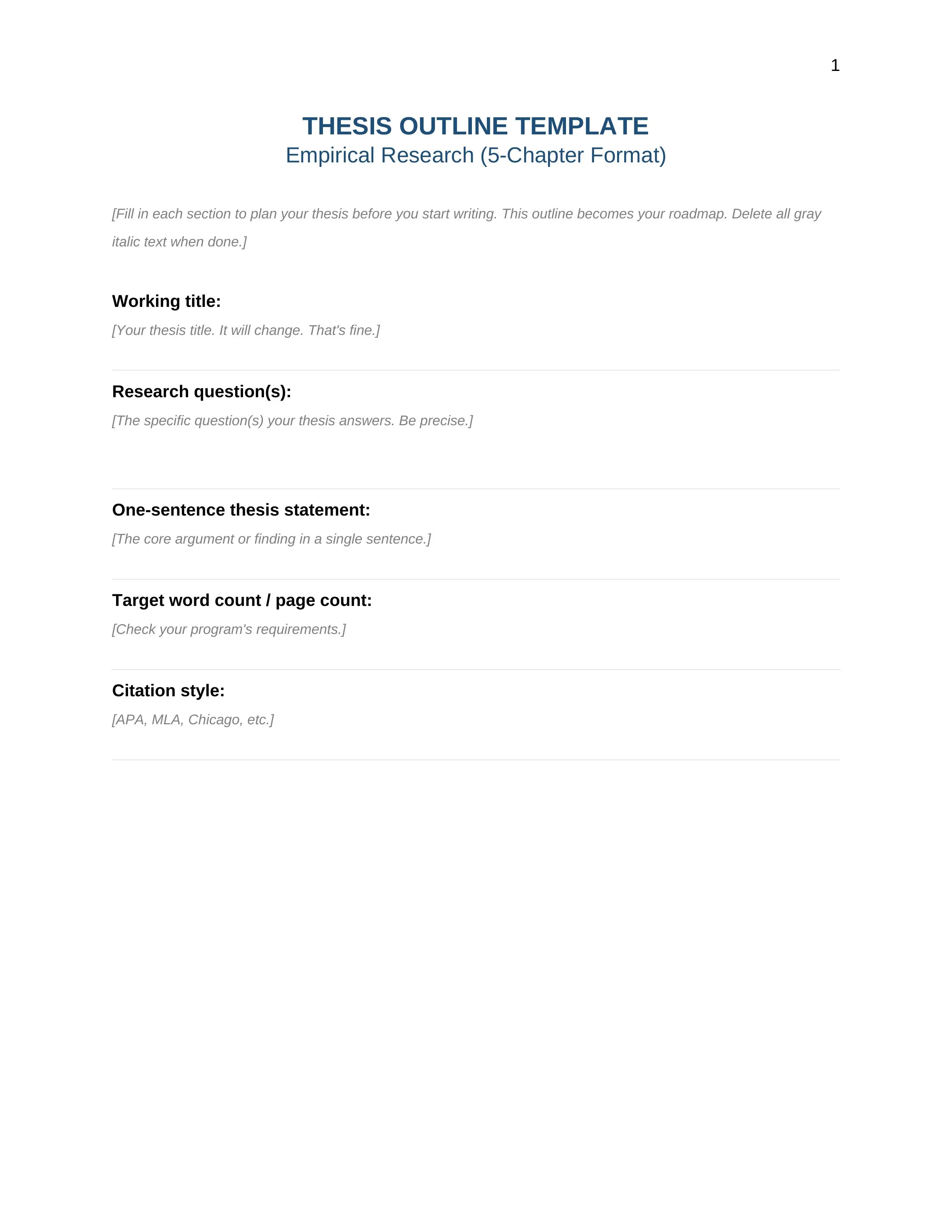
Download the free Formatli Thesis Outline Template (.docx)
Frequently Asked Questions#
What is thesis structure?
Thesis structure is the organizational framework that determines how a thesis is divided into chapters, sections, and subsections. It defines what goes where and in what order. The standard thesis structure for empirical research uses five chapters: Introduction, Literature Review, Methodology, Results, and Discussion.
What are the 5 chapters of a thesis?
The five chapters are: Chapter 1 (Introduction), Chapter 2 (Literature Review), Chapter 3 (Methodology), Chapter 4 (Results), and Chapter 5 (Discussion). This five-chapter thesis structure is the most common framework across the sciences, social sciences, education, nursing, and business programs.
Is thesis structure the same as thesis formatting?
No. Thesis structure is about intellectual organization: what content goes in which chapter and how the argument flows. Thesis formatting is about document presentation: margins, fonts, spacing, and page numbers. You need both, but they’re different tasks. Our thesis formatting guide covers the formatting side.
What is a thesis outline?
A thesis outline is a planning document that maps each chapter, section, and key point before you start writing. A good thesis outline template includes fields for chapter purpose, subsection headings, key content, and source lists. Planning your outline first prevents major restructuring later.
How is a humanities thesis structured differently?
Humanities theses typically use a three-chapter structure: Introduction and Context, Analysis, and Conclusion. Instead of presenting empirical data, the analysis chapter builds an argument through close examination of primary sources (texts, artworks, historical documents). Some humanities theses expand this to four or five chapters.
What is a manuscript-format thesis?
A manuscript-format thesis bundles two or three journal articles with a general introduction and conclusion. Each article chapter follows journal format (introduction, methods, results, discussion). This format is common in STEM programs and produces publishable work alongside the thesis.
Should I write my thesis in order?
Many students find it easier to write out of order. Start with the methodology chapter (you know what you did), then results, then literature review, then discussion, then introduction. The introduction works best when written last, because only then do you know exactly what your thesis covers.
How do I know which thesis structure to use?
Your program determines this. Empirical research (experiments, surveys, interviews) uses the five-chapter structure. Argumentative or interpretive work (textual analysis, historical research) uses the three-chapter humanities structure. Published-paper compilations use the manuscript format. Ask your advisor if you’re unsure.
Is there a free thesis outline template?
Yes. Our free thesis outline template includes both the empirical five-chapter format and the humanities three-chapter format. Each variant has planning fields for chapter purpose, subsections, key points, and source lists. No signup required. For the document formatting template (margins, fonts, page numbers), see our separate thesis formatting guide.